
The Runner's Guide to a Longevity Running Routine (and Finding Joy in Every Pace)
- LeMar Johnson
- Apr 16
- 6 min read

Let’s be real for a second. When was the last time you went for a run and didn't look at your watch?
For a lot of us, running has turned into a numbers game. We’re obsessed with the splits, the heart rate zones, the PRs, and, let’s not forget, the validation of a "good" Strava post. Somewhere between our first 5K and our third marathon, the "joy" part of LOVE JOY RUN got buried under a mountain of data.
But here’s the secret: your body doesn’t actually care about your pace. Your nervous system doesn't give a damn if you’re hitting a 7-minute mile or a 12-minute mile. It cares about movement. It cares about the sun on your face and the rhythm of your breath.
And if you’re building a longevity running routine, this matters even more. Because the longest running journey usually isn’t powered by grit alone—it’s powered by joy. The kind of joy that makes you lace up even when nobody’s watching. The kind that turns “I have to run” into “I get to move.”
If you’ve been feeling like running is a chore lately, or if you’re worried that your "best years" are behind you, this guide is for you. We’re breaking this down into a carousel of mindset shifts to help you rediscover why you started moving in the first place—so you can keep running (happily) for the long haul.
Slide 1: Focus on the Feel, Not the Finish
We’ve been conditioned to think that a "good" run is a "fast" run. But what if we redefined success?
Instead of chasing a specific number, try chasing a specific feeling. How does the ground feel under your feet? Is the air cool or warm? Research shows that staying present in the moment is a direct link to happiness. When you’re hyper-focused on your pace, you’re living in the future (the finish line) or the past (the last mile's split).
Try this: Leave the watch at home once a week. Or, if you can't bear to be "off the grid," cover the face of your watch with a piece of tape. Run until you feel energized, not depleted. This is about movement as medicine, not movement as a punishment.

A realistic photo of a runner in their 40s smiling while running through a sun-drenched park, looking relaxed and focused on the scenery rather than a watch.
Slide 2: The Magic of the "Easy" Gear
Did you know that the world’s most elite runners spend about 80% of their time running at a pace that feels "boringly easy"? It’s true. Most of us make the mistake of running our "easy" days too hard and our "hard" days too easy.
When you embrace a slower pace, you give your body a chance to actually enjoy the process. You can breathe through your nose. You can have a conversation. You can actually look at the trees. Finding joy in a slow pace isn't "settling", it's training smart.
If you're curious about how this actually makes you faster in the long run, check out our deep dive on polarized training vs. pyramidal training. It’s a game-changer for your recovery and your mental health.
Slide 3: Age is a Context, Not a Limit
"I'm too old to be fast." "My knees can't handle it anymore."
We hear this all the time. But here’s the truth: your pace might change as the candles on your birthday cake increase, but the joy doesn't have to. Running at 50 or 60 can be just as rewarding as running at 25, maybe even more so because you’ve traded ego for appreciation.
The key to running at any age is respecting your body’s need for maintenance. As we get older, we need to be more intentional about how we support our joints. This means prioritizing things like strength training for runners and understanding that muscle building is your best defense against injury.

A high-quality, realistic image of two runners in their late 50s sharing a laugh during a light jog on a coastal trail, dressed in simple, minimalist running gear.
Slide 4: Rediscover Your "Why"
Think back to the very first time you went for a run. Why did you do it? Was it for the fresh air? To clear your head after a long day? To prove to yourself that you could do something hard?
Over time, our "why" often gets hijacked by external pressures. We start running because we "should" or because we’re training for a race that we don’t even really want to do.
Take a moment to reflect. If there were no races, no social media, and no watches, would you still run? If the answer is no, it’s time to find a new "why." Maybe your "why" is simply the 30 minutes of quiet time it gives you away from your phone. That is more than enough.
Slide 5: The Social Connection
Running doesn't have to be a solo sport. In fact, one of the fastest ways to inject joy back into your miles is to share them with someone else.
Social connection is one of the strongest predictors of long-term happiness. When you run with a friend, the perceived exertion actually drops. You’re so busy talking about your weekend plans or that new show you’re bingeing that you forget you’re even working.
Whether it’s a local run club or just a weekly date with a neighbor, find your tribe. And if you need a little more structured support, a virtual running coach can help you find that balance between social fun and personal goals.

A realistic photo of a diverse group of runners of various ages and sizes finishing a run together, high-fiving and looking genuinely happy.
Slide 6: Change the Scenery (Literally)
Are you running the same 3-mile loop every single day? No wonder you’re bored!
Our brains love novelty. A simple change in scenery can trigger a hit of dopamine that makes the run feel effortless. Try a "race-cation" or just drive 15 minutes to a trail you’ve never explored.
If you’re a road runner, try the trails. If you’re a trail runner, try a track. Use your runs as an excuse to be a tourist in your own city. Experience is the best antidote to a running rut. If you're looking for more ways to boost your stamina while exploring new paths, we've got some tips on building endurance that fit perfectly with a new scenery plan.
Slide 7: Practice Gratitude in Motion
It sounds a bit "woo-woo," I know. But hear me out.
Next time you’re out there and it starts to feel hard, or you start judging your pace, try a gratitude scan.
I am grateful for my lungs for taking in this air.
I am grateful for my legs for carrying me.
I am grateful for these shoes that protect my feet.
When you shift from "I have to do this" to "I get to do this," the entire energy of the run changes. This is especially important if you’re recovering from an injury or dealing with tight muscles. Instead of being frustrated with what your body can’t do, celebrate what it can do today. (And if those hamstrings are still bothering you, remember that the hamstring usually isn't the real problem).

A realistic, minimalist photo of a runner standing still for a moment on a scenic overlook, eyes closed, taking a deep breath with a peaceful expression.
Slide 8: Give Yourself Permission to Pause
Sometimes, the most "joyful" thing you can do for your running is to stop running for a few days.
Burnout is real. If the thought of putting on your shoes makes you want to crawl back into bed, listen to that. Take a week off. Do some yoga. Go for a long walk. Focus on dynamic stretches instead of miles.
Running will always be there when you're ready to come back. The goal is to keep the relationship healthy for a lifetime, not just for a season.
Finding Your Joyful Pace
At LOVE JOY RUN, we believe that fitness should add to your life, not subtract from it. Whether you are 25 or 75, training for your first half-marathon or just trying to get around the block, you deserve to feel good while you move.
Stop letting the data dictate your happiness. Reclaim your run. Find your joy. And remember: every pace is a good pace if it's moving you forward.
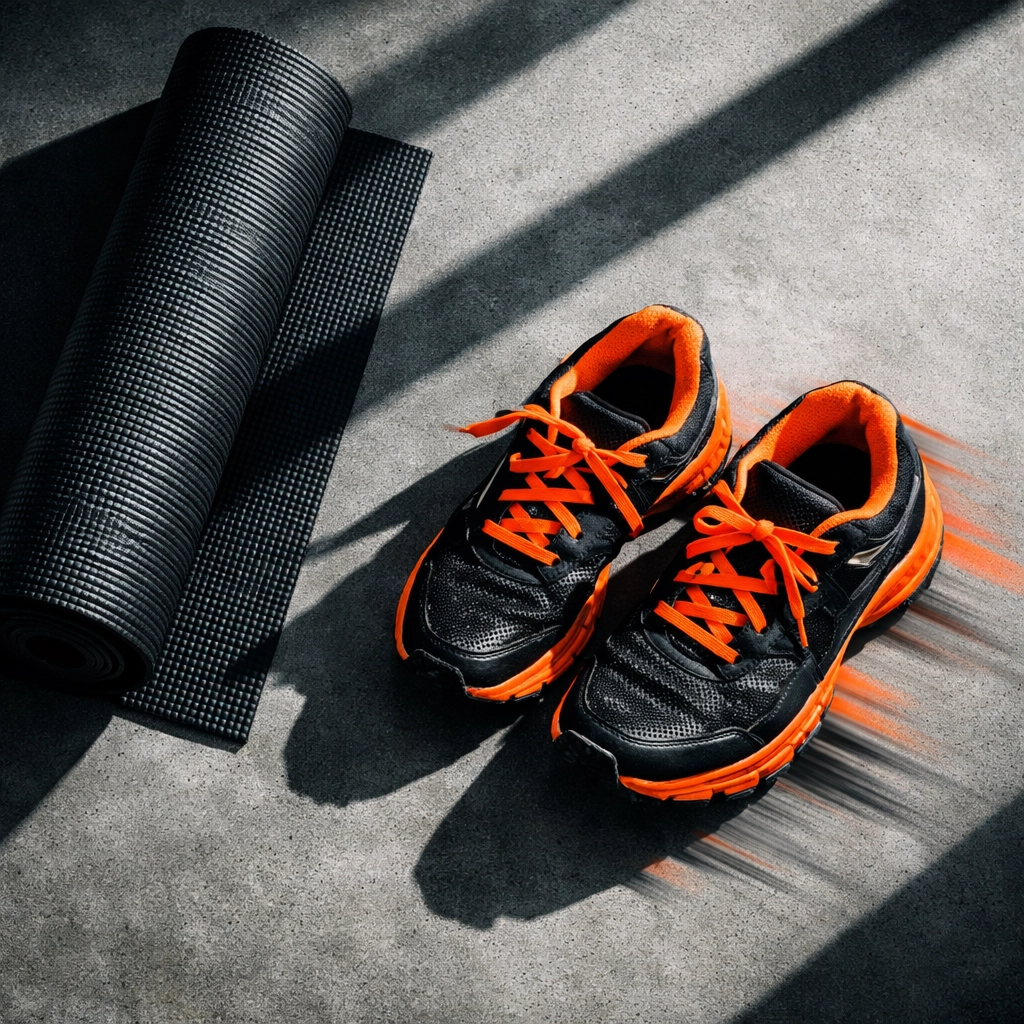
A realistic image of a minimalist, clean home gym space with a pair of well-worn running shoes and a yoga mat, suggesting a balanced approach to wellness.
Ready to change your relationship with running? Check out our tailored running programs designed to help you find that perfect balance between performance and pleasure. Let's get moving( together!)

Scan this QR code to join the LOVE JOY RUN Tampa club!


Comments